
Spiral Residential StairS
Custom aluminium spiral stair, engineered and drafted for residential installation. Fabrication-ready drawings, compliant with Australian standards, and optimized for hand lifted installation.
PROJECT OVERVIEW
Spiral stairs provide a compact and efficient vertical circulation solution where floor space is limited or where an architectural feature is desired. Unlike conventional straight stairs, spiral stairs rotate around a central column, significantly reducing the footprint required within a building.
They are commonly used in residential homes, mezzanine access, rooftop access points, and architectural feature installations where both functionality and visual impact are important.
Spiral stairs can be fabricated from steel, aluminium, timber, or a combination of materials depending on structural requirements, installation constraints, and aesthetic intent.
Prometheus Engineering provides custom spiral stair design and fabrication drawings, allowing builders and fabricators to manufacture and install stairs efficiently with clear workshop-ready documentation.
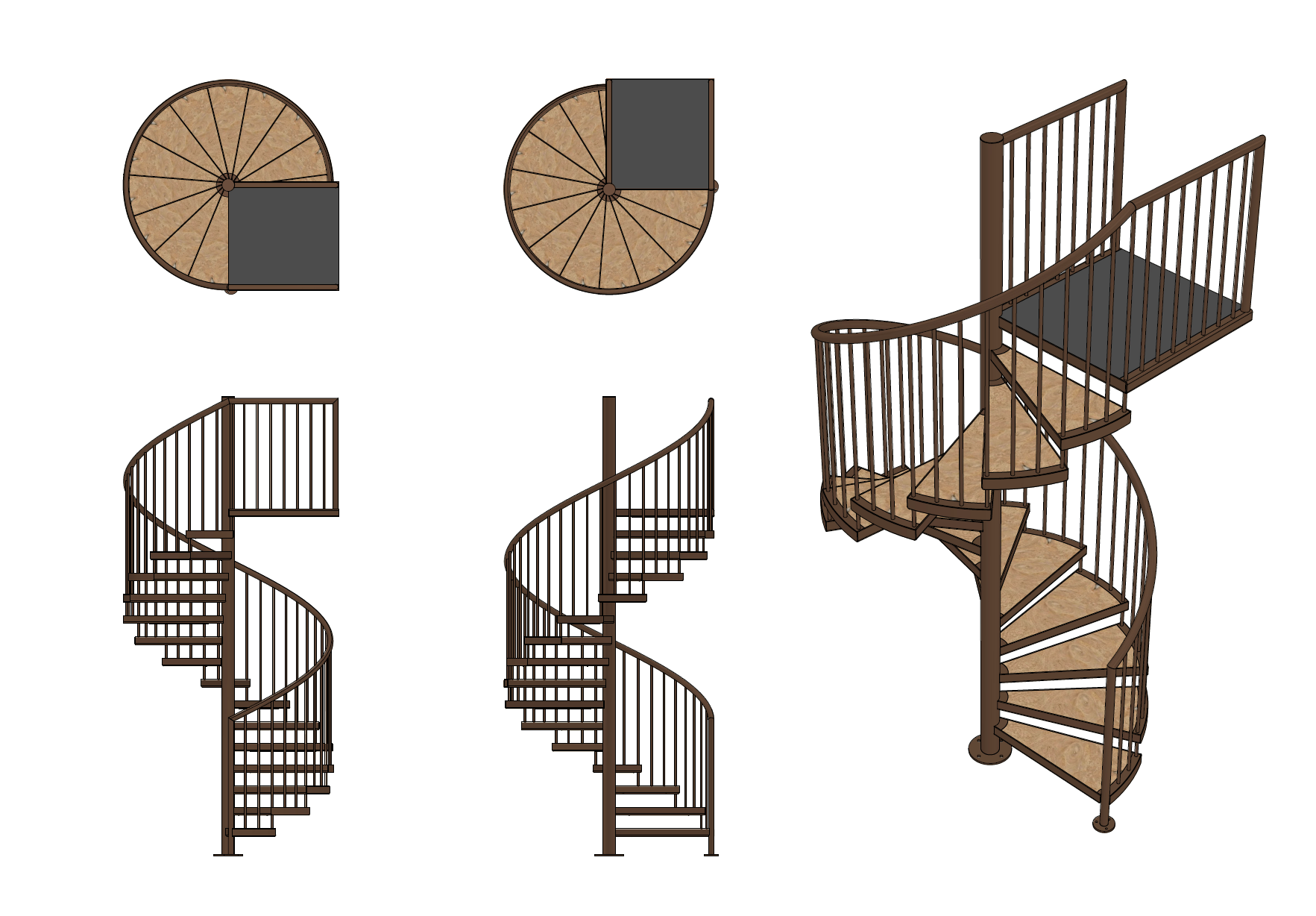
Technical Specifications
| Feature | Specification |
|---|---|
| Stair Type | Residential Spiral Stair |
| Primary Material | Aluminium stair structure |
| Tread Construction | Folded aluminium U-section treads |
| Tread Finish | 32mm timber inserts |
| Lighting Provision | Integrated concealed tread lighting cavity |
| Powder Coat Finish | Dulux Electro® Dark Bronze – Flat |
| Structural Support | Central CHS column with outer handrail post |
| Installation Fixings | M16 chemical anchors to centre post, M12 anchors to handrail post |
| Design Service | Custom stair design and fabrication drawings |
ENGINEERING & CONSTRUCTION
Designing a spiral stair requires careful consideration of structural loading, tread geometry, head clearance, and compliance with Australian building standards. Accurate drafting ensures the stair integrates correctly with surrounding floors, landings, and balustrade systems.
For this project, final relative levels (RLs) were determined early in the design phase to account for the finished tile thickness and ensure the upper landing and stair aligned correctly with the building structure.
The stair was fabricated from aluminium to minimise weight while maintaining adequate structural performance. Each tread was folded into a U-section profile to increase stiffness while providing a concealed cavity suitable for integrated ambient lighting.
Timber inserts were installed into each tread to provide a durable walking surface and a warmer architectural finish.
DESIGN CONSIDERATIONS
A key constraint for this project was installation access. The stair components needed to be manually transported and installed without crane assistance, requiring the structure to remain lightweight while maintaining structural integrity.
To improve fabrication accuracy and installation efficiency, the stair treads were designed with tab connections that inserted into laser tube cut slots in the central CHS column. This allowed each tread to be positioned and aligned quickly before being tack welded in place.
Balustrade installation was simplified by tube-cutting holes through the landing and balustrade rails, allowing the balusters to pass through and be fixed cleanly while maintaining alignment.
This design approach reduced fabrication time while ensuring the stair could be welded with consistent geometry.
Fabrication Strategy & Challenges
| Feature | Specification |
|---|---|
| Installation Constraint | No crane access – stair components designed for manual lifting |
| Weight Optimisation | Aluminium construction used to reduce stair weight |
| Tread Connection Method | Tube-cut slots in CHS column with tabbed tread connections |
| Fabrication Accuracy | Pre-aligned tread insertion system for fast installation |
| Balustrade Construction | Tube-cut balustrade penetrations allowing balusters to pass through rails |
| Manufacturing Process | Laser cutting, tube cutting, folded plate fabrication |
| Installation Strategy | Sequential tread placement with tack welding |
Frequently Asked Questions
-
The cost of a spiral staircase in Australia depends on several factors including the stair diameter, materials, structural requirements, and installation complexity. Residential spiral stairs typically range from $6,000 to $20,000+ depending on whether the stair is a simple prefabricated unit or a fully custom fabricated design.
Custom spiral stairs that incorporate steel or aluminium fabrication, glass balustrades, timber treads, or architectural finishes will generally sit toward the higher end of this range. Engineering design, fabrication drawings, and installation constraints also influence the final cost.
Because every project is different, spiral staircases are usually designed specifically for the building layout and floor levels rather than supplied as a standard product.
-
Spiral stairs require significantly less floor space than conventional straight stairs. Most residential spiral stairs in Australia have a diameter between 1500 mm and 2200 mm, depending on the building layout and compliance requirements.
The required space is determined by several design factors including:
stair diameter
tread width and rise
head clearance
balustrade location
landing configuration
Careful stair design ensures the spiral stair fits within the available space while maintaining safe and comfortable step geometry.
-
Yes. Spiral staircases are commonly custom designed to suit the building layout, structural requirements, and architectural style of the project.
Customisation options can include:
Stair diameter and height
Steel or aluminium construction
Timber, steel, or glass treads
Integrated lighting
Powder coat or architectural finishes
Glass or steel balustrades
Custom spiral stair design allows the stair to integrate correctly with surrounding floor levels, structural supports, and interior finishes.
-
Yes, spiral staircases can comply with Australian building regulations when they are designed correctly. Stair geometry, balustrade heights, and safety requirements are generally governed by the National Construction Code (NCC) and AS1657 / relevant building standards depending on the application.
Key compliance considerations typically include:
Minimum head clearance
Maximum riser height
Minimum tread width
Balustrade height and spacing
Structural loading requirements
Professional stair design ensures the spiral stair meets these requirements while still fitting within the available building space.
READY TO Start Your CUSTOM Stair Project?
Whether you're designing a residential spiral stair or a complex architectural staircase, we can develop fabrication-ready drawings tailored to your project.